How do social categorization and boundaries change during societal transformation? I have spent the last decade exploring this sociological question across diverse geographical and empirical contexts, including how migration reshapes ethnicity, citizenship, and nationalism in the China–North Korea borderland, how the rapid COVID-19 mRNA vaccine roll-out created societal ruptures in Singapore, how patient categorization in China’s nationwide healthcare reform turns primary care into a new site of social stratification, and what socio-material frictions within universities and between science and society the societal impact movement at Dutch universities unfolded. Across these projects, I repeatedly encountered a striking paradox: the programs and reforms designed to promote social, economic, and health equity often generate new forms of stratification, which lead to experiences or feelings of displacement, and a profound sense of alienation.
Drawing on sociological theories of everyday boundary formation and the social organization of difference (Brubaker; Barth; Vertovec), social acceleration (dynamische Stabilisierung), alienation, and resonance (Rosa; Jaeggi), and STS infrastructural analysis (Star; Larkin; Edwards), I examine the tensions and friction between top-down, large-scale reforms and the everyday life and work of people on the ground.
Academic Background and Journey
I hold a PhD in Sociology from Nanyang Technological University (NTU) Singapore. My early research explored migration, ethnicity, nationalism, and the formation of social categories and boundaries, with a geographic focus on Northeast China, South Korea, and North Korea.
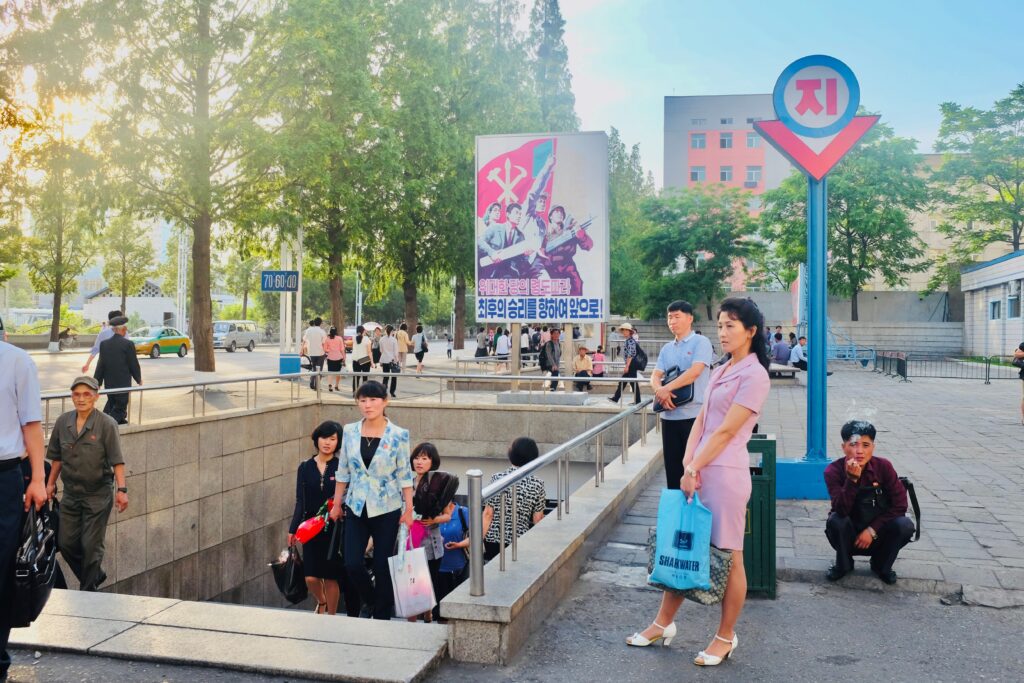
(I took this photo in Pyongyang, North Korea during my PhD multi-sited ethnographic fieldwork in June 2017. The state’s presence is constant here, from the towering propaganda billboard to the loyalty pins on everyone’s lapels).
While living and working alongside migrant communities, and witnessing firsthand how a lack of medical resources affected their everyday life and well-being, I developed a keen interest in healthcare research. This inspired my postdoctoral research in medical sociology and education at the Imperial College London–NTU joint medical school and the Nanyang Centre for Public Administration.
Since moving to the Netherlands in 2022, my work has been further embedded in Science and Technology Study (STS). At Erasmus University Rotterdam, my research examined the interdisciplinary and transdisciplinary infrastructures that help academia tackle issues of inequality, diversity, and inclusion. Currently, I am based at Vrije Universiteit (VU) Amsterdam, where my project examines Open Science Communities (OSCs) and their role in driving the cultural transition toward open science.
More about me
I was born in the late 1980s and grew up in Guangzhou, a large multi-ethnic city in southern China. Growing up in a popular migrant destination, I experienced the beauty and sparks of diversity from an early age: a rich culinary culture, diverse languages, and varied ways of thinking. That’s why I studied anthropology and sociology. Anthropology taught me to appreciate the wisdom generated in different cultures, and sociology drew my attention to social stratification. Spending extensive time with migrants and rural residents also made me see their everyday struggles, and a prominent one lies in the access to and quality of healthcare.
I spend my spare time sewing, rock-climbing, playing the Guqin (a Chinese string instrument) and cooking. Currently, my partner and I are writing a recipe book – Chinese Cooking in Europe: a guide to locally sourced Chinese classics. A newer hobby of ours is playing board games with our three-year-old daughter once our one-year-old is finally in bed.